









Biography Hein Braat
After practicing Hatho Yoga, Purna Yoga and Kriya Yoga for many years my opinion of what Yoga is changed. Every effort to search inward for universal love, light and unity, I consider to be a form of yoga. The Vedic Sanskrit “Sloka” and “Stotra” I do not sing in the traditional Hindu way, but I try to make maximum use of the powerful sounds of the Sanskrit language. Therefore, I consider correct pronunciation of vital importance. When allowing the melody to flow into words, instead of trying to fit the words into the melody, (like we do in Europe most of the time) the power of each word is preserved. If you compare words with vehicles, you could say that the fuel for each vehicle consists of tone, emotion and concentration.
Mantra
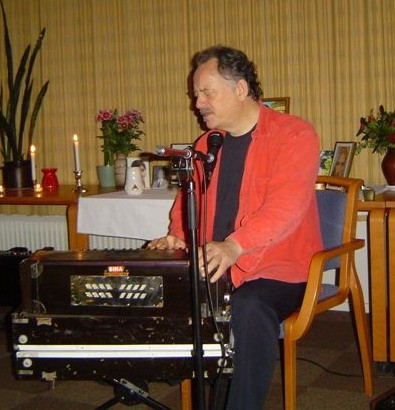
Since the age of thirteen, music has been a determining factor in my life. At first for pleasure, later on a professional basis. When I reached the age of forty my friend Hans van Druten advised me to practice Yoga for therapeutical purposes. I also happened to meet Yoga teacher Gerard van Wijk, who had just returned to the Netherlands, after spending three years as a monk in the Shivananda Ashram in Rishikesh, Northern India. Apart from teaching Purna Yoga he also sang and played a Hindu organ (Bat) during relaxation. He had an impressive way of singing and when I asked him what it was he had been singing, he explained that it was a Sloka from the “Rig-Veda”. That was the first time I heard someone sing a mantra. You could feel that it had to do with concentration and transfer of energy through the voice. After practicing this different way of singing at home, Hans van Druten gave me the lyrics to an old Sanskrit psalm and suggested I make a recording of it so it could be used in one of his seminars. This particular seminar focused on physically experiencing music in order to locate traumas. This psalm was the Gayatri mantra. Subsequently, I studied sitar for four years to improve my understanding of Hindu music and culture and the Sanskrit language for one year to master correct pronunciation.
 Music
Music
The Indian approach to music is fundamentally different from the European one. All music is played in one chord. The “C” chord (Bramha’s tone). The music is called “Raga” which literally means emotion. In previous times Raga was considered temple music and the various tone scales were ascribed to different emotions.
In ancient Yoga teaching, the human body was divided in 3 octaves:
1. The first octave: from the feet to the first chakra.
2. The second octave: from the first chakra up to and including the sixth chakra.
3. The third octave: from the sixth chakra up to and including the seventh chakra
In Europe one octave consists of twelve tones. In India one octave consists of 24 tones (1/4 tones). So the energy body of a human being is supposed to be made up of 72 “shrutis” or musical touch points. Musicians improvised on the tones of the Raga and played on the “shrutis” to achieve a specific state of mind. Modern day Indian Raga music is only distantly related to the old temple Raga.
Melody and Words
I still handle words and melody as I did before. Firstly, I focus on correct pronunciation of each word. Then I look for the power in each word (keeping in mind that Sanskrit is a sound language). I master the rhythm of the text. Subsequently, I concentrate on the central meaning of the text and transfer emotion into melody. Finally, I pour the melody into words. When you pronounce Sanskrit in the correct way, you can feel the sounds in different places inside your body. You are especially aware of this during singing. Not only is singing an emotional and mental happening, but it is also a very physical thing.
Spoken, thought or sung Mantra can be a way of meditation and so creating the possibility to experience the mystical essence of the great world religions. Universal love, light and unity.